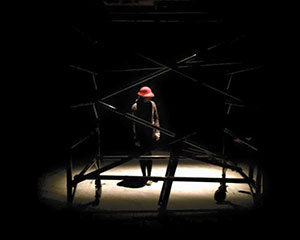
 Photo – Aslam Abdus-samad
Samuel Beckett is considered one of the most influential playwrights of the 20th century. The Nobel Prize winner was born in Ireland in 1906 but spent most of his adult life in Paris. He is famous for his minimalist approach and contributions to the Theatre of the Absurd.
Many of Beckett’s productions have strict guidelines that must be adhered to from the precise colour of costumes to detailed physical instructions that actors must follow. Glorious Thing Theatre Co has chosen four short plays by Beckett and if you have never experienced Beckett this is a fantastic show to introduce you to the world of one of the most highly regarded and greatly debated writers of the time. The four short plays are Quad, Come & Go, Rockaby and Catastrophe.
Quad opens with a cross of light on the floor across which four robed figures, in rhythmic and perfectly synchronised movements, follow a pattern across the stage. At intervals some will leave the stage and then return but the timing is never lost. Surrender to the tempo and you’ll begin to notice patterns; it becomes a little hypnotic and almost meditative. The music pulses and builds both momentum and suspense as the four walkers committed to their paths cross the middle of the cross without touching on another. Later the individual coloured robes are replaced by uniform white and the music is removed. The slap of bare feet beating out a cadence on the floor leaves your mind free to reflect on the effect the presence or absence of music or colour can have on a performance. In the aftermath of Quad, sitting in the dark waiting for what was next I wondered if this was an example of the genius behind Beckett.
Rockaby was the second performance and in the spotlight this time is a woman dressed in black played by Victoria Greiner. Beckett’s instructions “Black lacy high-necked … Long sleeves. Jet sequins … Incongruous headdress set with extravagant trimming to catch the light.” were followed to the letter. She sits in a rocking chair demanding more from a disembodied voice. The words are lyrical and tell the tale of the woman or perhaps someone she knew. The voice reading the poem is captivating and fills the darkness around the rocking woman. Yet again your mind fills in the gaps and a wonderful story can be found.
The third piece is Come & Go. Three women sit on a small bench. The darkness around them is echoed in the shadows cast by their hats that hide their eyes. This focuses attention on the lips; a twitch or a slight opening of a mouth might hint at who will talk next. The conversation is minimal but you know that they have a past together.
Talking to the actors after the show gave me a wonderful insight into how Beckett influences not only his audience but also the actors who take on the roles. Bodelle De Ronde shared how these limits open space for creativity. During the first rehearsals the three women developed their own stories for the characters. They came up with ideas that they believed valid in the setting. I didn’t ask what the stories were as I choose to give the women my own stories, but I loved learning that even actors so limited by Beckett’s directives, found a way to creatively put themselves into the characters.
The last piece Catastrophe has three on-stage characters, only two of them engage in conversation. A blonde female assistant and a man, the Director, who makes you feel uneasy from the moment he enters the stage, are the two most developed characters. The third on stage presence, played by Aslam Abdus-samad, is a man standing on plinth dressed in a hat and a black robe. He seems vacant but not by choice.
Gideon Payten-Griffiths plays the Director and does an excellent job of making you feel all kinds of apprehension and disquiet as he demands answers and issues commands in relation to the man the man on the plinth. Pollyanna Nowicki is his blonde assistant. She offers suggestions though few are accepted by the Director. This piece has a strong political feel to it, humans imprisoned, humans in power and at the end the defiance of the Catastrophe as he raises his head and for the first time appears human.
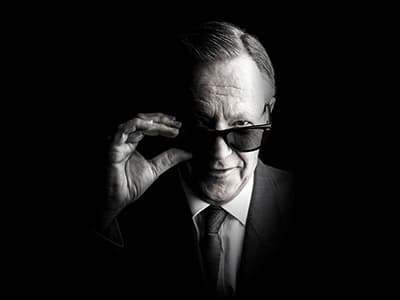
In between each performance Beckett look-a-likes moved props and staging into place. It was a nice touch as Beckett’s distinctive grey hair and scarf were almost as famous as his words. The four plays worked well together and gave the audience enough Beckett that left you wanting to know more about him. Maybe not a strong desire to see Waiting for Godot but a fascination with his work and other peoples opinions of the man.
Glorious Thing Theatre Co presents
Metafour
four short plays by Samuel Beckett
Venue: PACT | 107 Railway Parade, Erskineville, NSW
Dates: July 30 – August 15, 2015
Tickets: $22 – $33
Bookings: gloriousthingtheatreco.wordpress.com
Sydney Reviews
Metafour | Glorious Thing Theatre Co
- Details
- Emily Shaddick
Most read Sydney reviews
The Lark | Hey Dowling
Noni Hazlehurst brings Rose and The Lark to colourful and compelling life in this one-woman show.
Pride & Prejudice* (*sort of) | Neil Gooding Productions & Woodward Productions
This rollicking musical take on Jane Austen’s beloved novel is a side-splitting crowd pleaser.
Heartbreak Hotel | EBKM
Heartbreak Hotel invites its audience into an intimate portrait of the universal and isolating experience of heartbreak.
Current | Sydney Dance Company
While Bonachela’s work is, as always, dreamily lovely, for me the highlights were absolutely the three commissioned choreographers: Azzam Mohamed, Jenni Large and Raghav Handa.
The Gospel According to Paul – The Second Coming | Soft Tread Productions
The Gospel According to Paul is meticulously crafted entertainment. It’s uplifting without pulling any punches.
More from this author
Erth’s Dinosaurs | Erth Visual & Physical Inc
Stomping, growling, jaw-dropping, Erth's Dinosaurs at the Sydney Opera House is a show tha...
The Gospel According to Paul is meticulously crafted entertainment. It’s uplifting without pulling any punches.

While Bonachela’s work is, as always, dreamily lovely, for me the highlights were absolutely the three commissioned choreographers: Azzam Mohamed, Jenni Large and Raghav Handa.